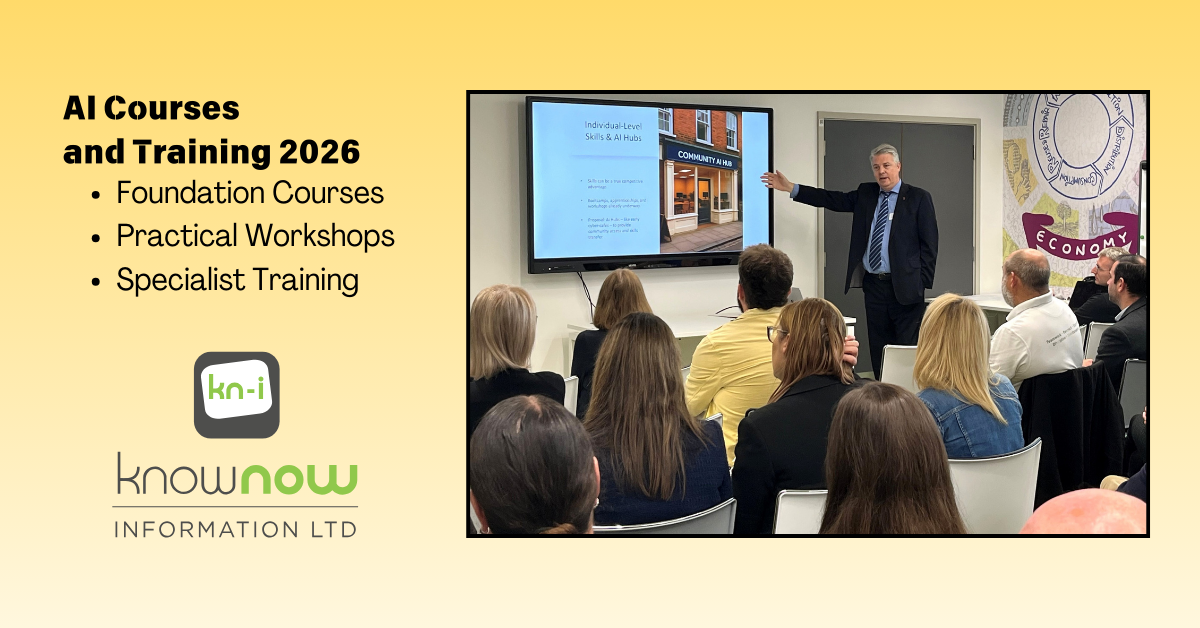
AI Courses and Training in 2026: Our Recommendations
A Clear Pathway from Foundations to Advanced Skills
Artificial Intelligence is no longer a niche technical subject. In 2026, it is a core workplace skill. The conversation has shifted from “What is AI?” to “How do we use AI effectively, safely and competitively?”
Whether you are a business leader, public sector professional, student, or technical specialist, there is now a clearer pathway than ever to build AI capability, starting with foundational literacy and progressing to advanced implementation skills.
This guide sets out a structured way to approach AI courses and training in 2026.
Not sure where to start?
If you’re unsure where to begin, think in terms of three stages:
1. AI Literacy
2. Practical Application
3. Technical Implementation
Each stage builds on the one before it.
Stage 1: Start with the UK Government’s Free AI Foundations Training
In 2026, the UK Government expanded its national AI skills programme, making free AI training available to all UK adults, with a goal of upskilling 10 million workers by 2030.
If you are new to AI or simply want a structured foundation, this is the ideal starting point.
The Government’s AI foundations training is designed to:
-
Explain what AI is (and what it isn’t)
-
Introduce generative AI and large language models
-
Cover practical workplace use cases
-
Address responsible and ethical AI use
-
Build confidence without requiring technical knowledge
This is particularly suitable for:
-
Business owners and directors
-
Managers and team leaders
-
Public sector professionals
-
Administrators
-
Anyone who wants to understand AI before investing further time or money
Starting here ensures you build literacy before moving into tools, platforms or technical development.
AI adoption is significantly more successful when leaders and teams understand the fundamentals first.
Stage 2: Attend a Practical Workshop
Once you understand the basics, the next step is application.
Across the South of England, initiatives such as the AI Growth Alliance (AIGA) are helping organisations move from theory to practice through workshops and collaborative sessions.
Workshops of this kind typically focus on:
-
Real-world business use cases
-
Process automation opportunities
-
AI strategy and roadmap development
-
Governance, compliance and risk awareness
-
Peer discussion and shared learning
This stage is where AI shifts from being an interesting concept to becoming an operational tool.
Workshops are particularly valuable for:
-
Leadership teams exploring AI strategy
-
SMEs looking to improve productivity
-
Public sector teams modernising services
-
Organisations seeking practical, low-risk entry points
For many organisations, this is the point where they identify tangible opportunities for automation, decision support, or service improvement.
Stage 3: Move to Technical and Specialist Training
If your goal is to build AI systems, deploy models, integrate AI into enterprise workflows, or develop data-driven products, you will need deeper technical capability.
This is where structured technical training becomes essential.
Advanced courses typically cover:
-
Machine learning fundamentals
-
Prompt engineering and generative AI systems
-
Retrieval Augmented Generation (RAG)
-
Data engineering and data architecture
-
Enterprise AI deployment
-
Governance and lifecycle management
-
AI integration into business systems
These programmes are suited to:
-
Data engineers
-
Developers
-
AI product managers
-
Technical architects
-
Innovation teams
-
Organisations building production AI solutions
This level of training is about moving beyond experimentation and into robust, scalable, secure AI implementation.
Why This Layered Approach Works
AI capability develops in layers.
Trying to jump directly into advanced model building without foundational understanding often leads to confusion, unrealistic expectations, and unnecessary risk.
A structured progression:
Foundations → Application → Technical Depth
creates:
-
Stronger strategic alignment
-
Better governance awareness
-
More sustainable AI adoption
-
Reduced operational and compliance risk
-
Greater return on investment
In 2026, AI success is not about chasing tools.
It is about building capability, thoughtfully and progressively.
Choosing the Right Course for You
Below, you’ll find curated recommendations across:
-
Foundational AI literacy
-
Practical business use
-
Technical and advanced AI development
Select the level that matches where you are today, and where you want to go next.
Websites
These are quick reads we’ve found genuinely helpful, either for brushing up on the basics or for sharing with clients and colleagues who are just starting out. They cut through the jargon and explain key AI terms, trends, and use cases in plain language. If you’re new to AI, or want to help others get up to speed, these are a great place to start. We’ve focused on accessible, high-quality pieces that don’t require a technical background.
AI Fundamentals & Key Concepts
Distinguishing between Narrow AI, General AI and Super AI – Tannya Jajal on Medium
https://medium.com/aiden-global/distinguishing-between-narrow-ai-general-ai-and-super-ai-a4bc44172e22
A plain-language explanation of AI types, clarifying what AI can realistically do today. Ideal for business leaders to separate hype from reality.
The Difference Between AI, Machine Learning, & Deep Learning — Codecademy
https://www.codecademy.com/resources/blog/difference-between-ai-machine-deep-learning-examples
Breaks down key terms using real-world examples (e.g. fraud detection, self-driving cars). Helps newcomers understand AI’s layers and relevance to business tools.
Generative AI Insights
What is Generative AI? – IBM Research
https://research.ibm.com/blog/what-is-generative-AI
A modern, jargon-free overview of generative AI, showing how it enables real business use cases like chatbots, drug discovery, and content creation.
The CEO’s Guide to Generative AI – IBM Institute for Business Value
https://www.ibm.com/thought-leadership/institute-business-value/en-us/report/ceo-generative-ai
An executive-level, free handbook for AI adoption. Offers practical frameworks and strategy tips across departments—ideal for leadership teams planning AI integration.
AI Applications in Business
AI Innovations: Improving Life in Unexpected Ways – Namecheap Blog
https://www.namecheap.com/blog/ai-innovations-improving-life-in-unexpected-ways/
Highlights real examples from airlines to elderly care. Shows how AI benefits small businesses, cuts waste, and opens new service models.
AI Trends – How AI Can Help Small Businesses – British Business Bank
https://www.british-business-bank.co.uk/business-guidance/guidance-articles/business-essentials/ai-trends-how-ai-can-help-small-businesses
UK-focused and SME-friendly, this article outlines realistic AI tools for admin, marketing, and customer service. Encourages action while acknowledging common barriers.
AI Tools & Platforms
Hugging Face Documentation
https://huggingface.co/docs
Access cutting-edge AI models (like ChatGPT equivalents) via an open platform. Their docs help non-experts use top-tier AI tools for free or low cost—great for experimentation and rapid prototyping.
AI Strategy & Responsible Use
Building an AI Business Strategy: A Beginner’s Guide – Harvard Business School Online
https://online.hbs.edu/blog/post/ai-business-strategy
Step-by-step advice for aligning AI with business goals. Excellent for C-suite or operations leaders looking to build long-term, ethical AI capability from the ground up.
AI Can Turbocharge Profits. But It Shouldn’t Be at the Expense of Ethics – World Economic Forum
https://www.weforum.org/stories/2024/01/ai-ethics-governance/
A short but powerful call for responsible AI. Balances innovation with trust and reputation—useful for boards, legal teams, and risk managers.
Papers
These are the longer reads we’ve found valuable when thinking about the bigger picture, whether that’s shaping policy, planning national AI adoption, or aligning business strategy with emerging trends. They include government roadmaps, executive briefings, and research-backed insights that go beyond the day-to-day. If you’re involved in innovation, leadership, or setting direction for your organisation, these are well worth your time.
National & UK-Focused Strategy Papers
National AI Strategy – GOV.UK
https://www.gov.uk/government/publications/national-ai-strategy
A 10-year vision to make the UK an AI powerhouse by boosting skills, infrastructure, and innovation. Provides long-term context for businesses planning AI adoption within a supportive national framework.
AI Opportunities Action Plan – GOV.UK (2025)
https://www.gov.uk/government/publications/ai-opportunities-action-plan
An action-oriented 2025 follow-up to the National AI Strategy. Highlights specific delivery measures—ideal for businesses wanting to align with government priorities and access AI growth opportunities.
Artificial Intelligence – Business.gov.uk
https://www.business.gov.uk/campaign/grow-your-tech-business-in-the–uk/artificial-intelligence/
A practical overview of the UK’s AI strengths, showcasing support for startups and scale-ups. Helps UK firms see the commercial case for AI and where to get started.
Applied Research & Business Insight
Insights from Heterogenous Data Through Transitive Semantic Relationships and Text Analysis – Sage Ralph- University of Southampton
https://eprints.soton.ac.uk/470732/1/David_Ralph_PhD_Thesis.pdf
This doctoral thesis, sponsored by KnowNow Information, presents practical methods for extracting explainable insights from large, unstructured datasets using transitive semantic relationships. Grounded in real UK case studies, it demonstrates how academic research can directly support business and government applications, showcasing a successful research-to-practice journey led by a KnowNow-supported researcher.
AI Revolution: Productivity Boom and Beyond – IBM Institute for Business Value
https://www.ibm.com/downloads/documents/us-en/10a99803ce2fdd5c
Makes the business case for AI as an engine of productivity. Targeted at executives, it weighs benefits vs. risks and offers strategic guidance on how to adopt AI at scale with purpose and governance in mind.
Courses
These are the courses our KnowNow team has completed ourselves or at least reviewed closely. They cover everything from the basics of AI to more advanced topics like prompt engineering, ethics, and strategic planning. As part of our curated list of AI Courses 2026, these are the ones we think genuinely deliver value. Whether you’re leading a team, exploring tools, or just getting started, there’s something here to suit your pace. We focused on free courses but have included paid options where relevant, and noted who each one is best suited for.
Recommended AI Courses for Business Users & Developers
Prompting Essentials – Google
https://grow.google/prompting-essentials/
A free, beginner-friendly course that teaches how to design effective AI prompts in five clear steps. Great for improving productivity in data analysis, writing, and summarisation tasks. Reviewed by KnowNow.
https://www.coursera.org/specializations/ai-essentials-google
Google AI Essentials is a self-paced course designed to help people across roles and industries get essential AI skills to boost their productivity, zero experience required. The course is taught by AI experts at Google who are working to make the technology helpful for everyone.
LinkedIn Learning – AI & Data Courses
https://www.linkedin.com/learning/
Paid, certificate-bearing courses ideal for professionals looking to demonstrate AI skills on CVs and LinkedIn profiles. Offers a wide variety of business-aligned content with professional recognition.
AWS Skill Builder – AI/ML Pathways
https://aws.amazon.com/training/digital/
Subscription-based learning platform with hands-on cloud-based AI training. Ideal for businesses building services on AWS or upskilling technical teams for cloud-integrated AI.
IBM SkillsBuild Learning
https://skillsbuild.org/adult-learners/explore-learning/artificial-intelligence
A free platform focused on management-friendly AI overviews, digital literacy, and responsible tech use. Good starting point for non-technical professionals. Reviewed by KnowNow.
IBM AI Training – Technical Tracks
https://www.ibm.com/training/learning-paths-and-collections
High-quality paid courses targeting intermediate to advanced learners. Offers certifications and training on Watson, AI governance, and model deployment. Reviewed by KnowNow.
DeepLearning.AI – Course Hub
https://www.deeplearning.ai/
Includes free and paid content from top AI educators. Excellent for developers looking to deepen their knowledge in areas like LLMs, prompt engineering, and applied ML. Reviewed by KnowNow.
Udemy – AI Courses
https://www.udemy.com
A popular platform with a vast range of AI topics, from beginner to expert, mostly paid. Good for structured learning on a budget, with user reviews and practical exercises.
Codecademy – AI & Data Science
https://www.codecademy.com/catalog/subject/artificial-intelligence
Offers interactive coding-based AI content. A strong follow-up for learners who’ve completed basic AI overviews and want to try real-world programming in Python and ML. Free and paid options available.
Courses With Strategic Focus for Business Leaders
AI Strategy for Business Leaders – Coursera / Packt
https://www.coursera.org/learn/packt-ai-strategy-for-business-leaders-with-chatgpt-ml-dl-uel66
Designed for non-technical executives, this course teaches how to evaluate AI use cases, ROI, and risk. Uses real-world examples (including generative AI) to help you build an actionable AI strategy. Free to audit.
AI Business School – Microsoft
https://learn.microsoft.com/en-au/training/paths/transform-your-business-with-microsoft-ai/
Free business-focused learning pathway co-developed with INSEAD. Offers guidance on scaling AI, building a data culture, and implementing governance—ideal for enterprise leadership teams.
Trustworthy AI: Managing Bias, Ethics, and Accountability – Johns Hopkins / Coursera
https://www.coursera.org/learn/responsible-ai-and-ethics
Covers AI fairness, transparency, and ethics. Equips professionals with tools to recognise and mitigate bias in AI systems—essential for responsible deployment in regulated sectors.
Short Courses for Hands-On AI Skills
ChatGPT Prompt Engineering for Developers – DeepLearning.AI
https://www.deeplearning.ai/short-courses/chatgpt-prompt-engineering-for-developers/
A compact (~90 min) technical course that walks developers through effective prompt design and real-world LLM use cases. Practical and efficient. Reviewed by KnowNow.
Generative AI for Everyone – DeepLearning.AI via Coursera
https://www.coursera.org/learn/generative-ai-for-everyone
Explains how generative AI works and how it’s used across business functions. No prior experience needed—ideal for leaders and managers exploring GenAI opportunities.
AI for Everyone – Coursera / Andrew Ng
https://www.coursera.org/learn/ai-for-everyone
A globally popular non-technical introduction to AI. Helps professionals identify use cases, work with technical teams, and confidently lead AI projects. Free to audit.
Elements of AI – University of Helsinki / Reaktor
https://www.coursera.org/learn/ai-for-everyone
Free and internationally recognised. Designed for beginners with no coding background, it builds solid AI foundations through theory and examples. Available in multiple languages.
0 Comments